Monday, January 14, 2013

Audience participation time!


Big non-book decision time, you guys.

Since I started this blog I’ve been trying to figure out whether I should do that thing where I can sell ad space on it through Blogger. My artistic/commercial instincts don’t war with each other so much as fluctuate in importance according to my level of employment; ever since I settled into a good full-timer I haven’t looked into it like I intended to.   

But I want to start initiating a couple things that will get me a little more money by doing absolutely nothing once I get them settled (finding a better interest rate for my savings account, putting tasteful ads on a blog I’d do anyway…um…), so here’s where you help me by telling me if you’d still read my blog if it had an ad on the bottom of each post:
  • Yes!
  • No!
  • Who cares! Not I!

Also, my 2013 New Year’s resolution is really just “read all the books in the original pile that I started recording 18 months ago before the 2-year mark of this blog.” My progress has been extraordinarily slow on that, but I counted, and on the original pile that doesn’t include any books I’ve since borrowed and haven’t yet read or since bought and haven’t yet read, there are four left.

FOUR.

And what makes me even happier is I’ve still got a bajillion and seven lined up after these, so I can totally feel accomplished while still having plenty left to read. There really is no such thing as too many books. 

What's for dinner?


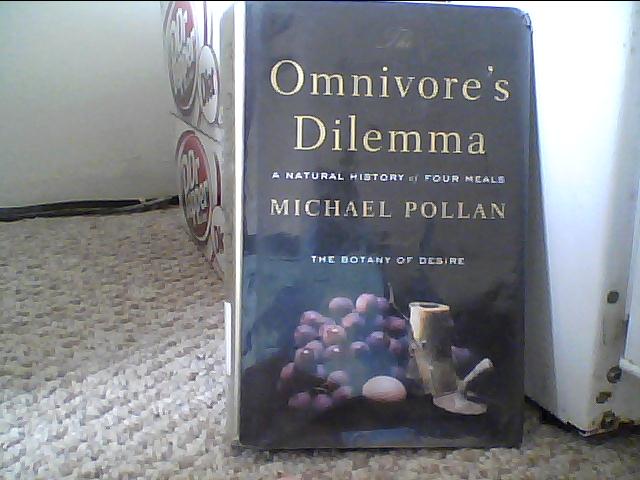
Book: The Omnivore’s Dilemma: A Natural History of Four Meals

Author: Michael Pollan

Published: 2006 (Penguin)

Pages: 411 (plus end notes)

Everything I try to write about this book makes it sound dull and over-obvious.

  • “Hey! Did you guys know that we Americans eat a shit ton of corn in our diets and that it isn’t even as, like, real corn?”
  • “We’re totally doing farming wrong but the people with the biggest stakes (heh) are too invested in the current system to change without losing a shit ton of money that shouldn’t even be there in the first place!”
  • “Organic farming’s grown into enough of an industry itself that it’s possible to buy organic TV dinners and the organic industry has this huge riff over whether that’s a good thing or not!”

Well duh. I’m not going to break any surprising ground (sorry, the farming puns will probably come of their own volition in this post) by telling you what I learned, nor will I pretend that I hadn’t heard most of it before. (Except for that organic TV dinner part. That sounds like the worst of both worlds.) But I swear this was a good book.


I almost feel like food writers are cheating a wee little bit because everybody eats, so everybody has at least a baseline interest in the topic. That doesn’t mean the good stuff isn’t compelling.

Pollan follows the production line of three different food gathering methods: industrial, organic, and gathering. He’s clear about his methods and reasoning and changes in plan as he goes along, which takes us with him on the journey as he watches corn get mashed up into the sugar for his McDonald’s soda and sees/smells/hears the difference between a feed-cow and a grass-cow and learns how to triangulate his vision to find mushrooms in their natural habitats. 
He explains everything clearly like a PBS narration, adding historical and business-y and national conversation-y bits about a topic after he’s seen it for himself and can add a personal perspective. He sounds like the normal-guy protagonist in a sci fi film who’s been taking along for the ride and gets to ask all the stupid/weird questions we want answered but that everybody else in the situation already knows.

The best bit (by a narrow margin because none of it’s bad) was when he talked about the ethics of eating animals. He outlines points made by animal rights people that if we think animals don’t have feelings and we don’t protect those feelings from the agony of slaughterhouses, we’re being speciest. He then points out a bunch of people on the other side that are all, “Hey, killing animals in quick slices and stretching them for food is a lot kinder than what would happen to them in the natural food chain.” Which – okay, that falls apart when you get to industrial farms that don’t let the animals live in the space and freedom they would otherwise, but if you go to small farms that let the animals do their natural grazing thing (which, by the way, perpetuates and stimulates farm growth cycles all by itself, like a self-winding clock) and manage to kill them in sanitary conditions that really do knock them out the first time, sounds like a good reason to keep eating local chicken.

So there was that, but I wasn’t overly fond of how he wrote the section where he went hunting for the first time. I don’t have strong feelings about hunting; but it irritated me to read his overly romantic description of the actual hunt juxtaposed with his overly horrified reaction afterwards. It’s by far the most personal-opinion and –experience-driven part of the book, and it’s like he wants to get the same exact approval from the two extreme kinds of people who will be most riled up by it.

And when he was done gathering and started reflecting on the meal he made almost entirely from things he had foraged himself, he got sappy about the circle of life, but he also revealed that you can gather natural yeast by filling a bowl with flour and water and waving it around outside your window. Seriously. That junk’s just floating around, apparently. I wonder what Columbia-yeast bread tastes like – humidity and mosquitoes and river water and ambulances and college kid beer? Anyway, that was sufficiently interesting enough to keep me distracted while he thanked all his friends and crap.

Going back to the library’s bookshelf! If it were my own copy, I would definitely keep in on my shelf, although I don’t know what sort of re-readability it has.   

Saturday, January 5, 2013

Chasing the dream

Book: Humbolt's Gift

Author: Saul Bellow

Published: 1975 Viking first edition, 1995 this Penguin Paperback edition

So you're lifelong friends with a crazy poet and his lovely verses that have dried up and his violent temper that's only gotten worse, right, and you don't see him once they lock him away in a mental home, and then he dies, and you try to go figure out what this legacy he left you is all about, but you're interrupted by a wife who's divorcing you for everything you've got, a minor but noisy gangster trying to collect on a gambling check that bounced from the one and only poker game you've ever played with him, and your gorgeous mistress wants to get married for depressingly practical reasons, and none of them know exactly how broke you're going.

What do you do? 


If you're Charlie Citrine, you roll with it. Your late-life rich-boy crisis is peppered with metaphysical jibberjabber, but thankfully interrupted by the more straightforwardly lunatical things in life, like how to take care of your lover's kid when she dumps him on you and leaves to elope to an undertaker during your trip to Europe.

If you're Charlie Citrine, you talk and worry an awful lot about money in a way that makes me think maybe "broke" to you who's earned a couple million in your lifetime (through a Broadway play and being a famous history expert, which--could that ever happen past 1965?) means something different than it does to most people. But don't even worry too much about that, because if you're Charlie, that crazy-ass movie script that you knocked out with your poet friend for a joke in Princeton is going to become the smash movie hit the poet always said it would be, only you won't know or believe that until  your goon tells you and takes you to see it and pesters you to sue for copyright infringement so he can get a commission. 

The philosophy and Chicago-flavored wackiness are mixed so they balance each other out perfectly and reflect the scattered thought process of a man who thinks too much. Charlie is too humble for this to turn into Rich Old Man with Problems, but this also makes it a little hard to believe that he's as famous as everyone else reminds him he is, which is supposed to be part of what makes his problems as abstract as they seem sometimes. 

But it's a good, spirited mediation on death and what we really need from each other and our cities and our bank accounts to get settled, and the happy ending is drawn out long enough to dismantle it as a deux ex machina. Still enough of one for me to be able to use the phrase "deux ex machina," though, which I don't count as a bad thing. Bookshelf!

By the way, my bookshelves are getting full, so I'm going to go ahead and open this can of worms: Any cheap AND interesting AND sturdy solutions to that? 

Wednesday, January 2, 2013

The book is always better


Book: Batman: The Dark Knight Returns
Author: Frank Miller
Published: 1986 (DC)
Pages: 188

A couple Saturdays ago, I convinced my boyfriend it would be a good idea for us to watch the DC animated version of The Dark Knight comic run DVD he had checked out of the library. He groaned, said the DC animations were all terrible, and then we watched it anyway so we could practice for our Riff Trax auditions.

It was, indeed, not good. Better than the Green Lantern promo (which apparently used The Incredibles’ nonunion knockoff imitator for their CGI), though – and every time the paper comic came up, my boyfriend said it was one of the best. Cognitive dissonance and an empty afternoon got me to borrow it from him.


With only a couple hours and lunch between the animation and the comic, I couldn’t separate the two. I was reading all the cheesy ticks (lame trying-to-be-hip dialogue, lines of talking heads from TV giving too-pointed commentary, a bright sterile Arkham) straight from an illustrated script. So I put it down.

But about a week and a half later, I picked it up again, backtracked a few pages, and fell in. I got over the little hump where the animation had ended and discovered a better backstory for the ridiculous villains, the new Robin rapidly gaining her feet, and the newscasts getting more useful juxtaposed against the action they were talking about. Plus the Joker woke up and started releasing doll bombs that insulted people and cold fly. I KNOW.

And then Superman showed up, not quite randomly but definitely as a counterpoint to Batman. Superman’s introduction, in a row of panels where a waving American flag gradually morphs in his cape while he and the President are discussing duty off-panel, was my favorite bit of storytelling here. It did so much with beautiful simplicity.

The rest of the art was sort of ‘80s-tastic in a good way, with geometric shapes and non-neutral colors that stayed muted enough to keep focus on the whole picture. I liked that Robin was completely gender neutral and so distinctive at the same time, and I liked that the mayor was shaped a lot like the Joker’s bomb maker. I was waiting for them to be the same person (they’re not).

The story climax and ending suddenly jolted me into remembering that hey, this series is called the same thing as Nolan’s last two movies. But it’s just one (really crucial) detail; the rest is totally original and just as dark. The ending does make better and more interesting sense here because of what Batman does with it.

So – a keeper. My boyfriend has been long convinced, and now so am I.
  

Friday, December 28, 2012

Guys, this is totally chick lit


Books: Good in Bed and Certain Girls

Author: Jennifer Weiner

Published 2001 and 2008 (Washington Square Press)

Pages: 375 and 384

I want Jennifer Weiner to give herself good material to back up her excellent arguments about the state of literature. She’s such an articulate defender of “Hey, guys? You know, how about we don’t worry about calling stuff ‘chick lit’ and just have fiction for everybody?” on her website and in her interviews and press.

But honestly? Her novels are her own worst enemies in that argument.

They try hard for substance with a light touch, like when her protagonist Candice Shapiro learns that her ex-boyfriend Bruce wrote a column in a national magazine about loving a larger woman. Which would be Cannie. Awesome premise, ridiculous enough to be authentically funny but still recognized as mortifying and a good start on a journey of self-discovery.  

Not a good premise: having the premature baby from the end of Good in Bed grow up into a teenager with health issues who wanders aimlessly through reading her mom’s old scandalous book and wondering about her biological dad and halfway thinking about planning her bat mitzvah and tracking down her long-lost grandpa. And then – spoiler alert – her stepdad dies. DIES. DROPS DEAD OF A HEART ATTACK WITH NO FUCKING HINT.

I turned the next few pages of Certain Girls looking for the joke or the awakening from the nightmare, but NO. That actually HAPPENS.

A bigger problem than that truly random plot twist, though, is that the protagonist in each novel is not nearly as persecuted as she declares herself to be. For every one person who does her wrong (Bruce), she’s got friends and a supportive family and a dog and even strangers to reassure her that she’s awesome and will get through this. 

I love Cannie as a person, though. Not really as a character, because for all the stuff she goes through she doesn’t really change, but if she were real I feel like I’d want to eat fatty food and talk about pop culture and boys and help her try to get her dog to answer to a different name and compare writing ambitions with her.

That’s why I kept reading these books, and that’s why they ended up disappointing me. Donate. Sigh.


The writer lived down in Georgia


Book: Everything That Rises Must Converge

Author: Flannery O’Connor

Published: 1956 (Farrar, Straus, and Giroux)

Pages: 269

Pro tip: don’t read Flannery O’Connor to cheer yourself up. I might’ve mentioned that before, but it’s a damn good thing to remember. This book has nine stories; body count = 10. Only one of which is of natural causes.


Don’t go thinking you’ll need a hankie to mop up all the melodrama, though, because it’s the opposite. She writes so matter-of-factly in such deftly tuned dialects that backwoods psychopaths sound like the normal, sane majority of the world and then you creep yourself out when you realize you’re nodding along to the reasons a jealous grandpa is beating his granddaughter. (For being pure Pitts, of course, just like the no-good daddy who leads her into the woods with angry scowls and his belt while she claims she never let anybody beat her in her life.)

“Parker’s Back” was my favorite, about this tattooed guy who’s been careful to keep his back clear until one day he doesn’t know how to make up with his super-religious wife (or even why he wants to make up with her in the first place) so he gets Jesus tattooed on his one clean space and she hates it and calls him a blasphemer and the last scene is her watching him have a breakdown under their yew tree.

“Everything That Rises Must Converge” is good, too, a neat little dissection of ironic hatred twisting in on itself as a son takes great glee in watching his prejudice mother discover that she’s wearing the same hat as a black lady while they’re riding the bus (to the mother’s “reducing” class at the Y, which isn’t super important but is a detail I love). He takes way too much pleasure in watching her squirm and trying to strike up friendships with black people on the bus and then gets to watch her collapse of a heart attack when they get off.

Each story is creepy in its own take on the theme of the quiet horror and ugliness that runs through people and how believably and easily it fits into their lives. Bookshelf, of course. O’Connor is one of my writing role models in that she writes incredibly simply to make complex emotions clear without pulling any of their power. 

Monday, December 10, 2012

Changing lives since 1963


Book: It Changed My Life: Writings on the Women’s Movement

Author: Betty Friedan

Published: 1976 (collection; Random House)
\
Pages: 388

It’s a little worrying how relevant these writings still seem today in this space-age year of 2012. We still have wage issues, and dammit-they’re-our-own-bodies issues, and nobody’s even come close to working out how to put together a strong career and raising kids without compromising severe amounts of sleep.

Considering all that, these are smart writings by the lady who started it all. She tells you exactly how she started it all, and exactly where it started to get away from her, and at some point when she was discussing how the movement is (was, in 1975) fracturing, I wanted to tell her, “Lady, lesbians have feelings too.”

She puts these essays, news reports, NOW meeting notes, and interviews in rough chronological order, which is logical, but they’re each written for a slightly different audience, so there’s a lot of overlap. 
Especially when she gets to her McCall’s columns; those were written for a mass audience who didn’t know what feminism was actually meant to mean, so she tends to condescend and sentimentalize so Mrs. Still-a-Housewife won’t keep thinking that “equal rights for women” equals “bra-burning ladynazis who don’t need men.” She’s superadiment about still liking men, y’all, and I agree with her insistence on bringing men on board and making everybody equal instead of insisting that women are more awesome than men, but by the end she’s focusing way too much on why the new NOW leadership is too radical than what’s the next thing she can do about breaking the glass ceiling.

With intros sometimes as long as a piece itself, these writings get repetitive when read straight through. (My boyfriend says The Feminine Mystique is like that too. I wonder what she would think about that, about how equally we’ve shared the work of reading her writings.) BUT it’s an excellent collection with a piece for every audience, so it will go on my bookshelf.


Y’all, I’m trying to remember where I got this book. I honestly have no idea. It was free, though, and as such was worth it and more.