Thursday, October 10, 2013

Sweet, sweet research


Book: Candy Freak: A Journey Through the Chocolate Underbelly of America

Author: Steve Almond

Published: 2004 (Algonquin)

Pages: 261

This has the heft and layout of one of those novelty books stacked near Barnes and Noble cash registers, but it’s so much more in depth up front about that author’s obsession with candy.

He tours a lot of the smaller U.S. candy factories, as Mars and Hershey wouldn’t even pretend that they’d give him inside information, but he saw a lot of general processes. And got a lot of free samples. These parts were like watching those videos that the mailman brought on Mr. Rogers, only a little giddier and editorialized with heavier emphasis on chocolate bars simply because those are the author’s favorite.

He explores his own obsession, too, which is basically that his dad expressed fatherly love through candy. Although the author wonders about the true health of that, he backs off from a path of existentialism that is starts to lead him down a couple times (“Is this why I can’t keep a real relationship…? Ooh, a new flavor of Twix.”) Which I appreciated, because I read the whole thing over the course of a disconcerting Sunday that needed no more overthinking, especially about relationships.

But one thing I did enjoy was when he talked to fellow freaks, the ones that had written books and started empires. Although the guy who had a massive collection spanning decades and a couple hundred thousand dollars had nothing polysyllabic to say about it. The author kept in all the journalism awkwardness of trying to get a good answer, which was a funny look behind his curtain and a sort of terrifying look behind the old man’s because apparently he did all that for basically no reason. It could’ve been beer cans.

Tasty stuff, so it stays on the shiny new book cart.


Bravo!


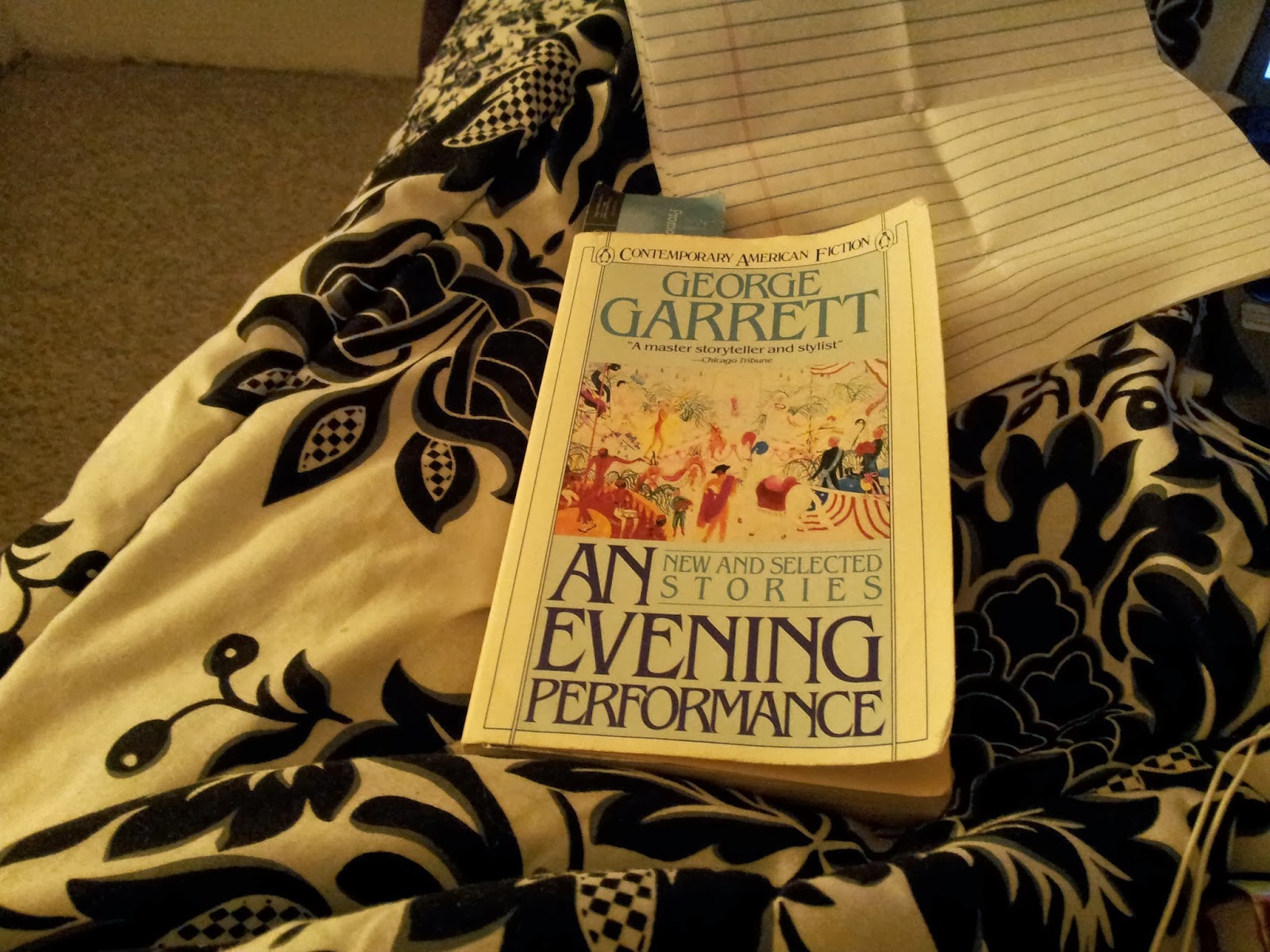
Book: An Evening Performance: New and Selected Stories

Author: George Garrett

Published: 1985 (Penguin)

Pages: 518

Where has this guy been hiding? Seriously, this book from the bargain bin of a used book store is the first time I’ve heard of him and it’s got like 100 short stories that are all at least good with quite a few that are transcendent.

He does best when pitting weirdos against a collected group (small town, usually) and they expect different things or levels of fulfillment. He also does really well with military stories, using false bravado to show the absurdity of war by exposing the gap between what a soldier does and how he feels about it and how he shows that.
 

The one place he stumbles is in the domestic sphere. Those stories feel like he’s trying to shoehorn too much meaning into too slight themes, and that makes it go melodramatic.

So but all of it’s worth reading. Bookshelf!


After...what?


Book: Afterwards

Author: Rachel Seiffert

Published: 2007 (Pantheon)

Pages: 327

The most boring part of this story is the central romance that comes together as a sort of “meh, why not” and floats away because of much more interesting traumas. Not that either side knows about these actually interesting traumas, just that there’s something the other’s not saying. Boo fucking hoo, y’all.
 

But the guy was a British solider deployed to fight the IRA with a rage problem that’s mostly under control except when he lashed out and killed a man on his last patrol, and the girl has a weirdly close relationship with her grandfather for how much she resents him and his own military participation in the colonialism of Kenya.

I liked reading about those two bits, and they were spread out nice and gradually among the modern day piffles, so I think I still want to keep this, but it’ll be on the first to-weed list when I run out of room (again).

Wednesday, September 25, 2013

Eight volumes in the life of an icon


Books: Buddha, volumes 1 – 8
Author and artist: Osamu Tezuka
Published: 2003 – 2005 translation from Vertical (mirrored artwork, so it reads left to right)
Page: Oh geez. I forgot to write that down. They average about 350 a volume, so, that times eight is 2,800. Ish.

Here’s where I’m coming from with Tezuka: I already know he’s awesome, thanks to my now-ex-boyfriend-but-still-book-friend’s research and enthusiasm and willingness to lend reading material, and I’ve wanted to read Buddha for a longass time but have only just found all eight volumes sitting on one library shelf.
 

And boy howdy I’m glad I got them all at once (“There’s a lady out here with a bunch of books…”) because I burned through them like the fire that’s always cropping up and burning villages to the ground and making orphans and vigilantes of everybody.

The storyline rests on the solidifying backbone of Prince Siddhartha, his quest to outsmart his fear of death, his enlightenment, and his spreading said enlightenment. It’s profound and spiritual without being overtly religious, and Tezuka’s so good at showing Siddhartha’s humanity in the lines of his face when he’s trying to stay stoic and his outburst of doubt and pain as he grows into his role.

What struck me most was the motif of sacrifice. Like, a rabbit throws itself into a fire so a starving monk can eat kind of sacrifice. Within the first ten pages. Life is short and brutal so why not make it count for more in the end, right? We’re all connected, and while that freaks me out a little for reasons I don’t really want to poke at, it provides an elegant flow to the life cycle and why (some) things happen.

This is heavy stuff, so I’m going to take a list to appreciate some of the ways Tezuka reminds us to not take everything so seriously:

·         Young Tatta is totally Astroboy. Right? Then as he grows up, Tezuka gives him this great galumphing walk and bloodthirsty vengeance that Buddha manages to tamp down, sort of, until the ink spray of Tatta’s violent arrow death.

·         Everything is so cyclic that more than once I thought about saying out loud to these books, “Can’t you people learn?” but then Buddha does that, and those are his best moments of humanity because he’s trying to enlighten you people, dammit.

·         Anytime anything ridiculous comes up, an explosion of Tezuka pig doodles burst into a panel to let you know. I think real life should have that sort of notation.

·         Is going topless just a thing in India, or was it in Buddha’s time? If so, that historical detail is recorded very thoroughly.

·         And on the topic of being completely superficial, why did Buddha’s hair become, like, I don’t know, is that stone? And why did his ears start drooping down? There wasn’t any mention of it except the visual, and it was too different for the explanation to be “well, he done got old.”

This is a good epic with lively artwork, engrossing scenery, interesting characters, and themes that tackle no less than humanity’s own place in the cosmos. Go read it.

Monday, September 16, 2013

How pottery tells us how much we don't actually know

Book: A History of Ancient Egypt: From the First Farmers to the Great Pyramid
Author: John Romer
Published: 2013 (Penguin)
Pages: 395 (not counting end notes)

Not going to lie here, y’all – you need to be already interested in ancient Egypt before you start this book. Otherwise it’ll be hard going. There’s a lot of pottery to sift through.

But that’s the good part; Romer is excellent at talking about what those pottery shards mean and how they, along with other stuff that you might recognize from conventional Egyptology tropes, piece together a very faint picture of an empire everybody thought they knew.

This ain’t your grandma’s ancient Egypt, though. He dissects the modern, Western lens through which we’ve all been trained to look at the pyramids and archaeological finds and basically says that, look, we really have no idea what these mean, and what we’ve been using as facts are actually pretty bad guesses, so here are some better ones that come with giant caveats all meaning DUDES, WE WEREN’T THERE.

I want Romer to do this sort of check on like all known knowledge, just to make sure. He seems really good at it, and his writing is academic but not overly so. And this is just the first motherfucking volume, with another one to come, and I can only hope that he wrote all at one time and split them up because otherwise he’s probably sweating over a laptop with a doomsday clock ticking down on his wall right this second. I don’t wish hard deadlines on anyone, especially dudes who look like Elaine’s dad from Seinfeld and live in Italy (check the bio, yo).

This is a library book (picked fresh from the liberry tree!), so it’s going back, and I don’t think I’ll put it on my to-order list. It was good, I enjoyed reading it, but it took several breaks for lighter fair and never really felt fun enough for a re-read. I may or may not check out volume 2. We’ll see.


I feel like I have to put a disclaimer somewhere that I am not actually a librarian. I work in HR at a library, which is still awesome, and I plan on getting my MLIS eventually, and I can help you look something up on our online catalogue but…not a librarian. I mention this because I tried to distinguish it during a drunken discussion while watching a football game with people on Saturday, and I fear that was the worst possible scenario to get my point across.

But I’ll totally answer to librarian. Miss Bookstacks if you’re nasty, heh.


To tide us over until November

Book: Doctor Who Omnibus 1
Authors: Gary Russell, Leah Moore, John Reppion, Tony Lee, John Ostrander, Richard Starkings, Rich Johnston, Charlie Kirchoff, Tony Lee
Artists: Nick Roche, Jose Maria Beroy, Stefano Martino, Micro Pierfederici, Ben Templesmith, Paul Grist, Kelly Yates, Adrian Salmon, Eric J, Tom Mandrake
Published: 2013 (IDW)
Pages: 416

Dragon*Con loot, you guys! Actually my only piece of it besides the tract marks on my left elbow and the free t-shirt I got for giving platelets. That, by the way, is a terrible way to get over squeamishness of needles and blood. It took over an hour and I almost threw up.

Anyway, so continuing the trend of buying a book at each place I make a trip to, I bought this Doctor Who comic book, got one of the artists to sign it, and read like twenty pages the entire weekend. But when I got back, I had half a Labor Day still to kill so I celebrated by doing absolutely no labor except getting through these stories.

And I wish they had been selling a volume of just the six one-shots collected for the Through Time and Space section because those were all gorgeous and different and provocative in examining humanity. My favorite was the one where there’s a planet that’s being terrorized by a monster that feeds on empathy so the aliens have trained themselves to show no emotions but then when they die they record their last words onto these portraits that they hang in this gallery and they’re all emotional things they wished they had said to each other and Martha Jones gets all achy about how uselessly complicated they made things like that, and the art is this blurred-background-sharp-doodle-lines stuff that brings just the right things into focus.

Also they bring in Donna for a couple one-shots. OH YES. Except the one about the planet that treats its womenfolk as subhuman is a bit too on-the-nose when the crowd who buys this probably descended from the first 20th century ladies lined up to gain the vote.

The longer two stories that sandwich the one shots – eh. The first one’s got a convoluted plot about giant cat alien guardians of the universe, or something, I couldn’t work that out even as I was reading through it, and the second one’s guilty of leaning too heavily on nostalgia to solve its plotline, although it does use the TARDIS’s organic nature in a slowly revealed, brilliant way that gets ignored a lot.

I am glad I bought this, and I love the cover, and I read some of it while eating the best pulled pork and pecan pie in Atlanta at Fat Matt’s Rib Shack waiting for the blues band to set up. So of course I’m keeping it.  


The men and women next door

Book: Home Town
Author: Tracy Kidder
Published: 1999 (Washington Square Press)
Pages: 417

A policeman is a great person to focus on for the story of a town. A policeman who’s lived his whole life on the same street, knows the place inside and out, loves his job, but is getting into the first stage of possibly moving on to bigger things is even better.

The perspective of a poor single mom who came to the town on its university’s older student scholarship program is also really valuable. She’s got that outsider view of both sides – the elite Ivy League and the shitty by-the-month-apartment part of town – and how they interact with each other.

The small town lawyer whose OCD is rapidly getting the best of him…well, I mean he’s part of the town and its structure, too.

But the problem is the story never gets past these characters. It’s supposed to be the story of a town, specifically, and what the concept of “home town” means in general, and it barely touches on either of those, like at all. There’s some smattering of Northampton history at the beginning of a few chapters, and I guess I could argue that the policeman, single mom, and crazy lawyer all talk about their places in town in the natural order of talking about what they do in it.


I’m not going to argue that, though, because it doesn’t work. All of this is well-written and well-researched and well put together and I liked reading it, but I’m giving it away because I wanted it to be a lot heavier on the sociology of the concept of a town as the center of people’s lives. It fails in that.